
Buying a used EV starts with asking the same questions you would for any used car: what does it cost, what condition is it in, how well was it maintained, and will it fit your daily driving needs? But shopping for an electric vehicle adds additional questions about range, battery health and charging access, which can be just as important as price and mileage.
An EV’s range needs to cover daily driving, highway trips, cold weather conditions (which can reduce range) and longer trips away from home. Charging needs to be convenient for where you live, work and regularly drive. The battery also needs enough usable capacity and warranty coverage to justify the car’s price.
These 10 steps will help you research and buy a used EV that matches your driving needs, charging options and budget.
1. Determine your budget and driving needs
Start with what your EV will need to do and what it will realistically cost. Looking at some of the most affordable electric cars can help you find a good starting point.Your budget should go beyond the vehicle’s asking price. Insurance, registration, financing, tires, charging equipment, possible home charger installation and remaining warranty coverage can all affect the real cost of ownership. A used EV priced well below its original MSRP can be a genuine opportunity or a sign that its battery health, range or charging support has declined enough to explain the lower price.
Your driving needs matter as much as cost. A short commute with home charging is a very different ownership experience than long highway trips, apartment living with no on-site charging options, cold-weather driving, or relying mostly on public chargers. A used EV that works perfectly as a commuter car may be a poor fit as the only household vehicle if charging is inconvenient or the usable range barely covers your driving needs.
If you don’t have a specific model in mind, compare multiple EVs in the same price range to get a better sense of their capabilities and specifications. Battery size, range, charging speed, body style, warranty coverage and brand support can vary enough that two similarly priced EVs may not represent equal value or capabilities.
A plug-in hybrid is worth considering if home charging is not available or long trips without charging access are common, but it adds a gasoline engine, hybrid system and different maintenance questions that don’t impact a fully electric vehicle.
2. Figure out how much range you actually need
Range should be one of the first considerations in your used EV search. The number given in a listing may reflect the vehicle’s original EPA estimate, but not what that car can deliver today.Used EV range depends on many factors, including the model, battery size, battery health, weather, speed, terrain, tires, climate control use and driving style. Highway driving usually uses more energy than city driving, and cold weather can reduce the usable range. That’s one of the reasons any used EV you’re considering should have more range than you’ll need on a normal day.
Cutting it close on the range is risky. For example, if a normal daily round trip is 60 miles, a used EV with 75 miles of real-world range leaves little room for cold weather, detours, battery aging or missed charging. Extra range means fewer charging stops, more flexibility for unplanned trips and more room for battery capacity drops and loss of driving range over time.
You might not need one of the longest-range EVs. A shorter-range model can make sense for local driving, a second car or a predictable commute with easy charging, especially in a warmer, mild climate. What matters most is having enough flexibility for regular driving, plus occasional detours and unexpected challenges, like cold weather or a public charger that’s out of service.
3. Make sure charging is practical
Charging is the EV version of refueling. How often an EV needs to be charged depends on its range, daily mileage, weather, driving speed and access to chargers. Someone driving 25 miles a day in a 250-mile EV may only need to charge a few times a week, while someone with a shorter-range EV, a long commute or mostly highway driving may need to plug in much more often.Home charging is usually the easiest and most convenient setup for EV owners. Level 1 charging from a regular household outlet adds only a few miles of range per hour, which may work for low daily mileage needs but isn’t practical for most drivers. Level 2 charging is often more useful, though it may require a 240-volt outlet, EV charger installation, landlord approval, HOA approval or electrical work.
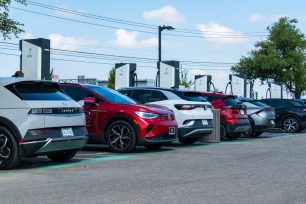
If home charging is not available, public and workplace charging become much more important. You can see how your area ranks for EV charging by city and state before assuming public charging will cover your needs. Check nearby chargers, common routes, charging speed, connector compatibility and whether the car can fast charge at a useful rate. Older EVs may have slower charging speeds or less convenient charging support than newer models, even if their range seems comparable.
Be sure to ask what charging equipment comes with the car. A missing mobile connector, adapter or charging cable may not be a dealbreaker, but it can add to your expenses and to-do list after your purchase.
4. Search for used EVs in your price range
Once your budget, range and charging needs are clear, you can start looking at used EVs for sale . Cars.com, Autotrader, iSeeCars.com and dealer websites can all help you search for and compare used EVs by price, mileage, model year, trim, features, distance from your location and more.For EVs, search filters should go beyond year and price. Battery size, range, charging speed, wheel size, driver-assistance features and remaining warranty can all affect a car’s value. Two EVs from the same model year with similar mileage may not be comparable if one has a larger battery, faster charging, better warranty coverage, or more desirable equipment.
Certified pre-owned EVs can be worth considering, but CPO vehicles at a dealership usually come with a higher price than a privately sold car. A CPO EV may include extra warranty coverage and has usually gone through a dealer inspection before sale. A private seller may still provide useful ownership details, charging habits or service records. The best choice depends on the specific car and its documentation, price and condition.
EVs often depreciate faster than gas cars, which can make used electric vehicles more affordable than shoppers expect. That lower price can be an advantage, but it still needs to be weighed against battery health, remaining warranty, usable range and your charging needs.
5. Check EV battery health and warranty
Battery health is the biggest difference between buying a used EV and buying a used gas car.Battery health helps show how much usable capacity the EV may have left compared with when it was new. The EV’s odometer reading still matters, but it’s important to understand how EV batteries lose range over time. A low-mileage EV with weak battery health may have less usable range and more long-term risk than a higher-mileage EV with a healthier battery and stronger warranty coverage.
Battery state of health, often shortened to SOH, is usually shown as a percentage of usable battery capacity compared with when the battery was new. It can be useful, but it is not standardized across or readily available for all used EVs. Some models will show battery or range information on their display screens, while others may require dealer diagnostics, service records, third-party battery reports, model-specific tools or seller documentation. An iSeeCars VIN Report shows an EV Range Analysis with estimated battery degradation, when the data is available. If clear battery SOH data is not available, you should put more weight on usable range, remaining battery warranty, inspection results and price.
Tesla shoppers can check for a Tesla build sheet online, which may include battery state of health data that’s not available for other EVs.
Warranty coverage is important because EV battery repairs and replacement can be expensive. Many EVs sold in the U.S. include a manufacturer’s battery warranty of 8 years or 100,000 miles, though coverage terms vary by automaker, model, year and state. Some states require more coverage, and some automakers provide longer battery warranties for certain EVs. The manufacturer’s battery warranty starts when the EV is sold new, so you should confirm the warranty start date, mileage limit, remaining coverage and transfer rules for the vehicle you want to buy.
Some battery warranties include capacity-retention coverage, meaning coverage may apply if battery capacity falls below a stated threshold during the warranty period.
When you’re buying a used EV, the goal is to understand how much battery life the EV still has, how much warranty coverage remains and whether the usable range supports the price.
6. Check the EV’s history
Getting a vehicle history report is an important part of researching any used car, whether it’s an EV, hybrid or traditional gasoline model. Depending on the provider and available records, a history report may show title brands, odometer events, salvage or flood records, theft records, reported accidents, registration history, open recalls and other reported events.CARFAX is a vehicle history report provider many shoppers know, but vehicle history reports are available from many companies. Other companies may use different data sources and show different information. Use a history report to check for title status, accident history, theft, salvage or flood branding, odometer readings and any other reported issues that could affect the EV’s value, insurability or repair risk.
A clean title does not automatically make an EV a good buy. A clean title generally means the current title does not show a brand for major issues, though title-brand rules and reporting vary by state. The vehicle can still have poor maintenance, prior repairs, an accident that didn’t result in a title brand, charging issues, old tires or hidden damage.
Flood history deserves extra attention for EVs because their high-voltage components and electrical systems are at higher risk from flood damage. This makes them more expensive to repair and, in some cases, unsafe. Recalls are also important. Some EV updates may be handled over the air, but others can still require dealer service, parts or inspection, so open recalls should be checked.
7. Check original pricing and options
A window sticker, also called a Monroney sticker, can confirm how the EV was originally equipped and priced when it was brand new. It usually includes the original MSRP, trim, standard equipment, factory options, packages, wheels and tires, MPGe or fuel economy information, destination charge, warranty information, and sometimes charging equipment or range-related details.This can be especially helpful when two used EV listings look similar but have different batteries, range ratings, wheels, driver-assistance features or factory packages. One may have a larger battery, different wheels, a higher original MSRP, upgraded driver-assistance features or a package that affects range or value.
Dealer-installed accessories and owner-added aftermarket equipment will not appear on the window sticker because the sticker reflects how the vehicle was configured and priced by the manufacturer when it was new. Items added by a dealer or a later owner, such as wheels, wraps, lift kits, audio upgrades, roof racks, charging accessories or appearance packages, should be checked separately.
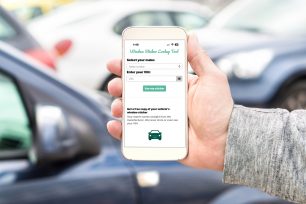
A window sticker lookup like the free Monroney Sticker Lookup by VIN site can help shoppers review an EV’s original MSRP, factory options, packages and equipment details.
8. Check what equipment the EV actually has
If a vehicle listing, seller description or window sticker still leaves you with questions about an EV’s equipment, you should try to confirm it has exactly what’s being advertised. Small differences in battery, drivetrain, software features, paint, interior or factory-installed equipment can affect the EV’s market value, maintenance needs and future resale value .A build sheet is helpful when a buyer needs to confirm how the EV was originally equipped and configured on the assembly line. It can show factory-installed equipment, production codes, paint and interior details, drivetrain information and other build data. That information can be particularly useful for Tesla vehicles, performance EVs, rare trims or packages, unusual paint and interior combinations, heavily optioned cars or EVs where battery, drivetrain or factory equipment differences affect value.
A build sheet can also provide codes and build details that may be useful later for parts, service or ownership records. You can use Build Sheet by VIN to check for a free build sheet.
9. Test drive and inspect the EV
You should always perform a test drive to confirm how the EV feels during regular use and whether the major systems work as expected. It should also give you a chance to check EV-specific items that may not show up in a listing, history report or photos.Before starting the car, do a visual inspection to look for any obvious damage. If there are no safety issues, take your test drive on roads that match how the EV will be used, including city streets, stop-and-go traffic, highways, hills or rough pavement when relevant. During the drive, pay attention to EV-specific items, as well as the standard checks in this used car test drive checklist.
Be sure to check the displayed range, warning lights, acceleration, braking, regenerative braking feel, steering, ride quality and any unusual noises. Regenerative braking can feel very different from one EV to another, especially if the car has one-pedal driving. Some drivers like that setup, while others prefer a more traditional brake feel. Many EVs offer a setting to change how the regenerative braking operates.
Also test the features that affect daily use. Make sure the infotainment system, climate controls, charging settings, driver-assistance features, cameras, sensors and app-related functions work as expected. Check the charging port, and if the seller says a charging cable, adapter or mobile connector is included, confirm that it is present and usable.
A pre-purchase inspection is recommended for any used EV, not just older or expensive ones. The inspection should be done by a mechanic, dealer service department or EV specialist familiar with electric vehicles. A regular used-car inspection should cover tires, brakes, suspension, steering, underbody condition and general wear, but an EV also needs attention to charging hardware, warning codes, cooling and thermal management systems, software updates and high-voltage-related concerns where appropriate.
EVs have fewer engine-related maintenance items than gas cars, but they are not maintenance-free. The main point is to use a mechanic, dealer service department or EV specialist who understands both regular used-car wear and EV-specific systems.
10. Make your final decision
After your research, test drive and inspection, your decision should come down to whether the EV is still worth buying at the price being asked. The best used EV options have enough usable range, clear battery information, remaining warranty coverage, a charging setup that works for you and no major issues indicated by the inspection or history report.Before agreeing to a deal, review the financing terms, dealer fees, warranty offers, charging setup costs and total out-the-door price. It’s also worth getting an insurance quote because EV insurance costs can vary by model and a lower purchase price does not always mean lower ownership costs. Charging costs like home charger installation can also affect the real cost if Level 2 charging is needed.
Negotiation depends on how flexible the seller is. Some dealers and private sellers may have room to adjust the price, while others might use no-haggle pricing or not be willing to accept less than the asking price. Either way, researching a specific EV’s market value before negotiating the price gives you a stronger basis for deciding whether the price is fair or whether another EV is the better choice.
The federal Previously-Owned Clean Vehicle Credit, a used EV incentive that reduced the purchase price by up to $4,000, is not available for vehicles acquired after Sept. 30, 2025. State, local and utility incentives for used EVs still vary and are worth checking before making your final choice.
Buying a used EV is easier when the biggest questions are answered before you buy: range, battery health, charging access, warranty coverage and total cost. Answering those questions up front makes it easier to choose a used EV that fits your driving needs, charging situation and budget.